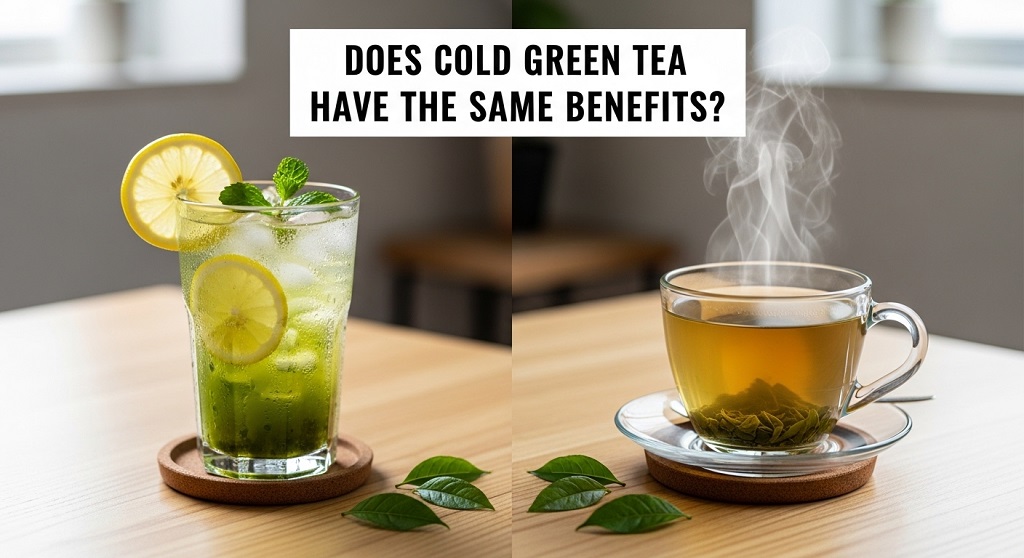
Many people drink green tea for antioxidants, metabolism support, and overall wellness. But one question keeps appearing: does temperature change its effectiveness? If you prefer iced green tea, you may wonder whether you are losing important nutrients compared to hot tea.
This guide explains exactly what stays the same, what changes, and how to maximize benefits from cold green tea without guessing.
Does cold green tea have the same benefits as hot green tea?
Snippet Answer: Cold green tea delivers most of the same health benefits as hot green tea, including antioxidants, hydration support, and metabolic stimulation. However, hot brewing extracts catechins faster and in higher concentrations. Cold brewing preserves delicate compounds and reduces bitterness, making both preparation methods beneficial but slightly different nutritionally.
Answer Block: Cold green tea provides nearly the same health benefits as hot green tea. Both contain antioxidants, catechins, caffeine, and hydration support compounds. The main difference is extraction speed. Hot water releases antioxidants faster, while cold brewing preserves flavor and reduces bitterness with slightly lower catechin concentration.
Green tea benefits come primarily from polyphenols called catechins. The most studied catechin is EGCG. This compound supports metabolism, cardiovascular function, and cellular protection.
Temperature influences how quickly these compounds dissolve. Hot water extracts them rapidly. Cold water extracts them slowly but steadily.

That means:
- Hot tea produces stronger antioxidant concentration quickly
- Cold tea produces smoother flavor with similar long-term value
- Both support hydration equally
- Both deliver caffeine stimulation
If steeping time is long enough, cold tea can approach similar antioxidant levels.
Most differences are practical rather than biological. Regular consumption matters more than temperature choice.
Does cold brewing reduce antioxidants in green tea?
Answer Block: Cold brewing slightly reduces immediate antioxidant extraction compared to hot brewing, but extended steeping compensates for the difference. Catechins still transfer into water during cold infusion, preserving most protective compounds responsible for green tea’s health benefits.
Antioxidants dissolve faster in heat because molecular motion increases with temperature. This accelerates catechin release from tea leaves.
Cold brewing slows that process. However, slower extraction does not mean weaker tea overall. It simply requires more time.
For example:
| Brewing Method | Steeping Time | Antioxidant Extraction Speed | Flavor Profile |
|---|---|---|---|
| Hot Brew | 2–3 minutes | Fast | Stronger, slightly bitter |
| Cold Brew | 4–8 hours | Slow but steady | Smooth and mild |
Research suggests longer cold steeping restores much of the antioxidant difference.
Cold brewing also preserves certain delicate compounds that degrade under high temperatures. This creates a balanced nutritional trade-off rather than a loss.
If maximizing antioxidants is your goal, increase steeping time instead of switching to hot preparation automatically.
Does cold green tea help with weight loss like hot green tea?
Answer Block: Cold green tea supports weight management similarly to hot green tea because both contain caffeine and catechins that stimulate metabolism. The temperature of the drink does not significantly change fat oxidation benefits when consumed consistently.
Weight loss support from green tea comes from two key compounds:
- Catechins
- Caffeine
Together, these increase thermogenesis. That means the body burns slightly more calories.
Temperature does not change their metabolic function once consumed.
However, cold green tea offers one practical advantage. People often drink more of it during the day. Increased intake leads to:
- Higher hydration
- Greater calorie replacement compared to sugary drinks
- Improved appetite regulation
- Better consistency in consumption habits
Consistency matters more than preparation style.
If iced green tea replaces soda or sweet beverages, the indirect weight loss impact becomes stronger than any temperature-related difference.
Does cold green tea contain the same caffeine as hot tea?
Answer Block: Cold green tea usually contains slightly less caffeine than hot green tea because caffeine extracts faster in hot water. However, extended cold steeping increases caffeine content, making the difference minimal for most daily consumption levels.
Caffeine extraction depends on three factors:
- Temperature
- Steeping time
- Leaf quantity
Hot water releases caffeine quickly within minutes. Cold water requires longer contact with leaves.
If steeped overnight, cold green tea can contain similar caffeine levels.
This matters for people seeking:
- Mental alertness
- Workout support
- Fat oxidation assistance
- Afternoon energy replacement for coffee
Cold tea often feels gentler because slower extraction reduces bitterness and tannin strength.
The stimulation effect remains present but smoother.
Is cold green tea better for hydration than hot green tea?
Answer Block: Cold green tea hydrates as effectively as hot green tea because hydration depends on total fluid intake rather than temperature. Both versions contribute equally to daily water balance and electrolyte support when consumed regularly.
Hydration benefits depend on liquid volume, not beverage temperature.
Green tea contains mild caffeine, but not enough to offset hydration benefits. Studies show it still contributes positively to daily fluid intake.
Cold green tea increases hydration indirectly because people drink more when beverages feel refreshing.
This is especially useful in warm climates where fluid loss increases through sweat.
Practical hydration advantages include:
- Encourages frequent sipping
- Reduces sugary drink consumption
- Supports temperature regulation
- Improves exercise recovery
Cold preparation therefore supports hydration behavior even if chemical composition stays similar.
Does cold green tea protect the heart like hot green tea?
Answer Block: Cold green tea supports cardiovascular health similarly to hot green tea because both contain catechins that help reduce oxidative stress, improve cholesterol balance, and support healthy blood vessel function when consumed consistently over time.
Heart health benefits come from antioxidant activity.
Catechins help:
- Lower LDL oxidation
- Support artery flexibility
- Reduce inflammation markers
- Improve circulation efficiency
These effects depend on total intake rather than beverage temperature.
Cold brewing may even improve long-term consumption habits because smoother taste increases adherence.
Regular intake matters more than extraction method.
Daily drinking patterns influence cardiovascular outcomes far more than preparation temperature.
Is bottled cold green tea as healthy as freshly brewed cold tea?
Answer Block: Bottled cold green tea is usually less beneficial than freshly brewed versions because processing, storage, and added sugars reduce antioxidant content. Unsweetened fresh cold-brewed green tea retains more catechins and delivers stronger health effects.
Commercial bottled teas vary widely in quality.
Many contain:
- Added sugar
- Artificial flavoring
- Preservatives
- Lower tea extract concentration
These changes reduce nutritional value.
Fresh cold brewing avoids oxidation loss during storage.
To maximize benefits:
- Use loose leaves when possible
- Steep 4–8 hours in refrigerator
- Store airtight
- Consume within 24 hours
This preserves catechins and flavor stability.
Fresh preparation consistently outperforms bottled alternatives nutritionally.
How should you prepare cold green tea for maximum benefits?
Answer Block: To maximize benefits from cold green tea, steep high-quality leaves in cold filtered water for 6–8 hours in the refrigerator. This method preserves antioxidants, reduces bitterness, and maintains caffeine content while improving drinkability and consistency of daily intake.
Preparation quality determines antioxidant availability.
Follow this method:
- Add 1 teaspoon loose green tea per cup of water
- Use filtered cold water
- Refrigerate 6–8 hours
- Strain before drinking
Avoid room-temperature brewing because microbial growth risk increases.
Refrigeration protects freshness and safety.
You can enhance benefits by adding:
- Lemon slices for vitamin C synergy
- Mint leaves for digestion support
- Ginger for anti-inflammatory effects
These additions improve both taste and functional value.
Consistency remains the most important factor for measurable results.
Conclusion: Should you choose cold or hot green tea?
Cold green tea provides nearly the same health benefits as hot green tea. Differences exist mainly in extraction speed, bitterness level, and caffeine release timing. Antioxidants, hydration support, metabolic stimulation, and cardiovascular protection remain available in both versions.
The best choice depends on lifestyle habits rather than chemistry.
If cold green tea helps you drink more consistently, it becomes the better option. Regular intake produces stronger long-term health effects than occasional hot tea consumption.
Fresh cold brewing offers an ideal balance between convenience and nutritional value. It preserves catechins, improves taste, and encourages daily hydration.
Start preparing cold green tea at home and replace sugary beverages with it. Small daily changes create meaningful long-term health improvements.
FAQ: Does cold green tea have the same benefits?
Does iced green tea lose antioxidants?
No. Iced green tea retains most antioxidants if brewed properly. Longer steeping times compensate for slower extraction, preserving catechin availability similar to hot brewing methods.
Is cold green tea good for metabolism?
Yes. Cold green tea supports metabolism because it contains caffeine and catechins that increase thermogenesis and fat oxidation when consumed consistently.
Can I drink cold green tea every day?
Yes. Daily consumption supports hydration, antioxidant intake, and cardiovascular health. Freshly brewed unsweetened tea provides the greatest benefits.
Does refrigeration reduce green tea nutrients?
No. Refrigeration preserves nutrients by slowing oxidation. It helps maintain catechin stability compared to leaving tea at room temperature.
Is cold green tea better than soda?
Yes. Cold green tea contains antioxidants and no added sugar when prepared properly, making it a healthier replacement for sweetened beverages.
Does lemon increase cold green tea benefits?
Yes. Lemon improves catechin absorption by stabilizing antioxidants and enhancing bioavailability in the digestive system.
How long should cold green tea steep?
Cold green tea should steep for 6–8 hours in the refrigerator to maximize antioxidant extraction and maintain smooth flavor.
Related Topics: How to Manage Lower Back Pain at Home Without Medicine
What Next: How to Plan a Low Phenylalanine Meal for Adults with PKU