Breast cancer risk beyond BRCA1 and BRCA2 refers to the many genetic, hormonal, lifestyle, environmental, and medical factors that influence risk even when these well-known mutations are absent.
Introduction: Why focusing only on BRCA genes can give a false sense of security
Many people believe breast cancer risk starts and ends with BRCA1 and BRCA2 mutations. That assumption is incomplete. Only about 5–10% of breast cancer cases are linked to inherited mutations, yet millions of women without these variants still develop the disease.
This misunderstanding creates a dangerous gap in awareness. Someone may test negative for BRCA mutations and assume they are safe. In reality, risk depends on a broader combination of family history, hormone exposure, lifestyle choices, breast density, age, reproductive patterns, and additional genetic variants.
Breast cancer risk beyond BRCA genes includes polygenic risk factors, hormonal influences, environmental exposure, and personal health history that collectively shape lifetime probability.
Understanding this wider risk picture helps people make earlier screening decisions, adopt preventive strategies, and interpret genetic testing results more accurately. The goal is not anxiety—it is clarity and control.
Why are BRCA1 and BRCA2 not the whole story?
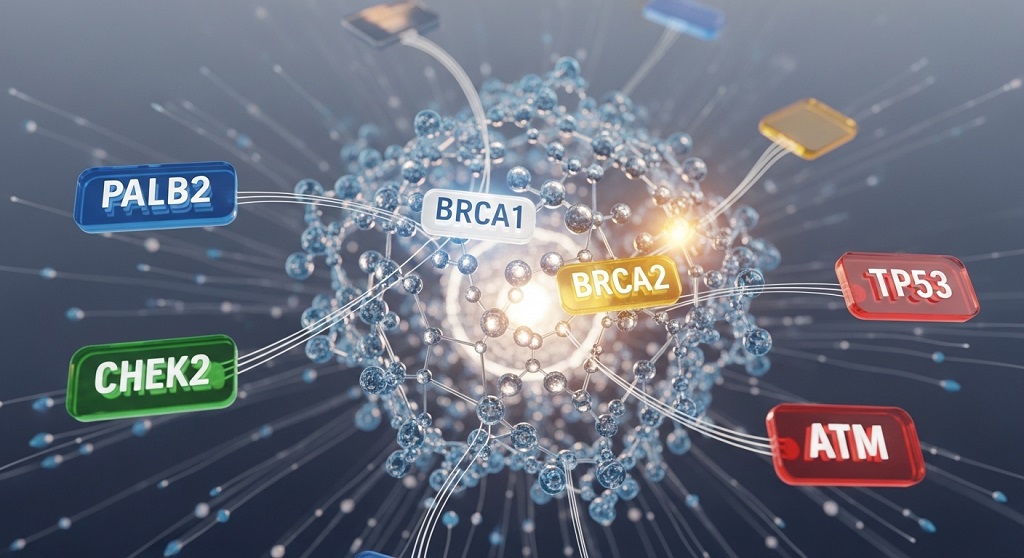
BRCA1 and BRCA2 mutations explain only a small portion of breast cancer cases, meaning most diagnoses occur in individuals without these variants.
These genes help repair damaged DNA. When they mutate, cancer risk rises significantly. However, they represent just two components of a complex biological system.
Other contributors include:
- Moderate-risk genetic mutations
- Polygenic risk scores (multiple small genetic variants)
- Hormonal lifetime exposure
- Breast tissue density
- Age-related biological change
- Lifestyle factors such as alcohol intake and physical inactivity
Relying solely on BRCA testing overlooks the majority of risk pathways identified in modern cancer epidemiology.
Which other genes besides BRCA1 and BRCA2 influence breast cancer risk?
Several moderate-penetrance genes such as PALB2, CHEK2, ATM, and TP53 contribute to breast cancer susceptibility.
These genes do not increase risk as dramatically as BRCA mutations, but their impact is clinically meaningful—especially when combined with family history.
| Gene | Risk Level | Clinical Significance |
|---|---|---|
| PALB2 | High–moderate | Can approach BRCA-level risk in some families |
| CHEK2 | Moderate | Associated with hormone receptor–positive breast cancer |
| ATM | Moderate | Linked to DNA repair function impairment |
| TP53 | High | Associated with early-onset cancers |
Multi-gene panel testing now helps identify these variants, improving personalized screening strategies.
What is polygenic risk and why does it matter?
Polygenic risk refers to the combined effect of many small genetic variants that together influence breast cancer likelihood.
Unlike single-gene mutations, polygenic risk accumulates gradually. Each variant adds a small increase in probability. When combined, they may significantly change lifetime risk estimates.
Researchers now use polygenic risk scores to:
- Predict earlier screening needs
- Identify individuals needing MRI surveillance
- Guide preventive medication decisions
- Refine population-level risk stratification
This approach represents a shift from “mutation present or absent” thinking toward probability-based prevention.
How does family history affect breast cancer risk even without BRCA mutations?
A strong family history can increase breast cancer risk even when genetic testing does not identify known mutations.
This happens because:
- Unknown genes may still be involved
- Shared environmental exposures influence risk
- Polygenic inheritance patterns exist
- Hormonal traits run in families
For example, having one first-degree relative with breast cancer nearly doubles risk. Two relatives increase risk even more.
Family history remains one of the most powerful predictors in clinical risk models such as the Gail Model and Tyrer–Cuzick Model.
Does breast density increase breast cancer risk?
Yes, dense breast tissue both increases breast cancer risk and makes tumors harder to detect on mammograms.
Breast density reflects the proportion of fibroglandular tissue compared to fatty tissue. Higher density is associated with a fourfold increase in risk compared with low density.
Dense tissue also reduces imaging sensitivity. As a result, supplemental screening such as ultrasound or MRI may be recommended.
People often discover density only after routine mammography reports. Understanding this factor helps refine screening schedules.
How do hormones influence lifetime breast cancer risk?
Longer exposure to estrogen increases breast cancer risk because estrogen stimulates breast cell growth over time.
Hormonal exposure begins earlier than many realize. Risk accumulates across decades through reproductive and medical history.
Key hormonal influences include:
- Early menstruation before age 12
- Late menopause after age 55
- Delayed first pregnancy
- Hormone replacement therapy
- Not breastfeeding
These factors do not cause cancer directly. Instead, they slightly shift the probability landscape.
Does age remain the strongest breast cancer risk factor?
Yes, increasing age remains the single most significant predictor of breast cancer risk in the general population.
Most diagnoses occur after age 50. This reflects cumulative DNA mutations over time combined with hormonal exposure and immune system changes.
However, younger individuals with strong genetic or family risk profiles still require earlier screening strategies.
Can lifestyle choices significantly change breast cancer risk?
Yes, lifestyle factors such as alcohol consumption, physical inactivity, obesity, and smoking can influence breast cancer risk.
Research consistently shows modifiable habits affect long-term outcomes.
- Alcohol increases estrogen levels
- Excess body fat raises inflammatory signals
- Sedentary behavior reduces metabolic regulation
- Smoking introduces carcinogenic compounds
Even modest improvements can lower risk across populations.
Does body weight after menopause affect breast cancer risk?
Yes, excess body weight after menopause increases breast cancer risk because fat tissue becomes a primary estrogen source.
Before menopause, ovaries produce most estrogen. After menopause, adipose tissue takes over hormone production. This shift explains why weight plays a stronger role later in life.
Maintaining a healthy weight reduces estrogen-driven tumor development risk.
What role does reproductive history play in breast cancer risk?
Reproductive timing influences breast cancer risk because pregnancy changes breast cell maturation patterns.
Earlier full-term pregnancy lowers lifetime risk. Later pregnancy slightly increases short-term risk but reduces long-term risk.
Breastfeeding provides additional protective benefits by reducing hormonal cycling exposure.
Do environmental exposures contribute to breast cancer risk?
Yes, environmental exposures such as radiation, endocrine-disrupting chemicals, and long-term pollution contact may influence breast cancer development.
Examples include:
- Medical radiation during adolescence
- Shift work affecting circadian rhythm
- Air pollution exposure
- Industrial chemical contact
While individual impact varies, cumulative exposure may shape long-term susceptibility.
Should people without BRCA mutations still consider genetic testing?
Yes, multi-gene panel testing can identify additional hereditary cancer risks beyond BRCA1 and BRCA2.
Modern testing evaluates dozens of genes simultaneously. It is particularly useful for individuals with:
- Early-onset breast cancer in relatives
- Multiple family cancer types
- Bilateral breast cancer history
- Male breast cancer in family members
Genetic counseling helps interpret results accurately.

How do doctors calculate overall breast cancer risk today?
Clinicians use predictive models combining genetic, hormonal, and lifestyle variables to estimate personalized breast cancer probability.
Common assessment tools include:
- Gail Risk Model
- Tyrer–Cuzick Model
- BOADICEA Risk Model
These tools help determine whether additional screening or preventive medication is appropriate.
Can screening recommendations change without BRCA mutations?
Yes, screening strategies often change based on combined risk factors even when BRCA mutations are absent.
Examples include:
- Earlier mammography start age
- Annual MRI screening
- Shorter screening intervals
- Preventive medication discussion
Risk-based screening improves early detection rates.
Are preventive medications useful for people at moderate risk?
Yes, medications such as tamoxifen and raloxifene can reduce breast cancer risk in individuals with elevated but non-BRCA genetic risk.
These drugs work by blocking estrogen receptors in breast tissue.
They are typically recommended when calculated lifetime risk exceeds clinical thresholds.
Conclusion: Why understanding the full risk picture improves prevention
Breast cancer risk is rarely determined by a single gene. BRCA1 and BRCA2 mutations are important, but they represent only one layer of a broader biological story that includes moderate-risk genes, hormonal exposure, family history, lifestyle factors, breast density, and environmental influences.
Recognizing this complexity allows earlier screening, smarter prevention decisions, and more accurate interpretation of genetic testing results. Instead of relying on a single test outcome, individuals benefit from a personalized risk profile that evolves over time.
If you have a family history of cancer or uncertainty about your screening plan, consider discussing risk modeling or multi-gene testing with a healthcare professional. Early awareness supports earlier detection—and earlier detection saves lives.
Understanding Non-BRCA Risk Factors
Frequently Asked Questions About Breast Cancer Risk Beyond BRCA Genes
Can you get breast cancer without BRCA mutations?
Yes, most breast cancer cases occur in people without BRCA mutations because lifestyle, hormonal exposure, breast density, and additional genes also influence risk.
What percentage of breast cancer is hereditary?
Approximately 5–10% of breast cancer cases are linked to inherited mutations, while the majority arise from non-hereditary risk factors.
Should I get screened earlier if my mother had breast cancer?
Yes, screening often begins earlier when a first-degree relative has breast cancer because family history increases lifetime risk.
Is dense breast tissue considered high risk?
Dense breast tissue increases risk moderately and can reduce mammogram sensitivity, making supplemental imaging beneficial for some individuals.
Can lifestyle changes actually reduce breast cancer risk?
Yes, maintaining healthy weight, limiting alcohol, exercising regularly, and avoiding smoking all contribute to measurable risk reduction.
Do men need to worry about hereditary breast cancer risk?
Yes, men with BRCA mutations or strong family history face increased risk and may benefit from genetic counseling and screening guidance.
Is multi-gene testing better than BRCA-only testing?
Multi-gene panel testing identifies additional mutations beyond BRCA genes and provides a more comprehensive hereditary risk assessment.
Read More Also How to Relieve Leg Swelling at Home with Proper Positioning
Discover More How to Get More Deep Sleep Every Night Naturally